Tuesday, April 17, 2012

Reflection: Unexpected Goodbyes

Saying goodbye is never easy, even under normal circumstances. That’s because we fear that when we say goodbye, we may 1) never see an individual again, or 2) see them again, but not get along, because people change. We are really wishing farewell to times shared together, which can always be remembered, but never relived. And that’s difficult.

Saying goodbye to our village too soon, as a result of the unexpected political changes in Mali over the past few weeks, has been one of the most challenging experiences of my life. Describing it seems equally as daunting as I am not sure I have truly dealt with it emotionally. I guess I always imagined that an evacuation would involve an adrenaline rush and maybe a helicopter rescue, but the reality was dealing with an anxiety of uncertainty and attempting to control what events I could. Throughout this entire ordeal, The Serenity Prayer has echoed in my head: “Lord, grant me the serenity to accept the things I cannot change, the courage to change the things I can, and the wisdom to know the difference.”

A few days after the coup d’etat (which you can read about in earlier posts), all Peace Corps volunteers got a message to consolidate to their regional capitals as a precautionary measure. Most of us figured that it was to simplify communication during an uncertain time and that we would be released in a few days. However, as the days added up from three, to six, to ten, we began to realize and fear that we may have already visited our village for the last time. For Joye, this meant not seeing her mudbrick school completed, and leaving behind so many unsaid thank-yous. For me, it meant being literally one day away from finishing the financing for a tree-planting project – it should have already been done, but the coup closed the banks on my last day in Duguba. With trouble in the north, and the threat of economic sanctions placed on Mali due to the coup, we distracted ourselves with painting mural and satirical blog posts (see prior entries) to avoid thinking about evacuation.

Then around dinnertime on Sunday we got an important email, which I read aloud to the nine young women of the Koutiala transit house who had been waiting with us for ten days. It said that we could go back to our villages until Friday, but volunteers in the region bordering the northern provinces had to be consolidated to the capital Bamako. Of course, we got ready to go back to Kongodugu, but the situation did not leave us confident that our return would be for long. Joye and I had a heart-to-heart, and decided that we would try to spend every remaining moment in Kongodugu as if it could be potentially be our last, which emotionally, is far easier said than done. But unlike some volunteers, we had control over this time, and therefore we were determined to maximize what time we had left.

But saying goodbye when you are not certain you are leaving is a difficult task. This is especially true in Mali, where people don’t talk about “just in case” scenarios, as they believe that even talking about the possibility of something bad happening makes it more likely to happen. So we stayed hopeful in our conversations, attempted to greet our closest friends, and share an intimate moment with them that in hindsight could be seen as a goodbye. On Tuesday, Joye held newborns, chatted with elders, took pictures of friends, thanked our host family, and encouraged the workers finishing up the school. She found that even the threat of being pulled out early, before we had intended to leave, made her appreciate our small and dusty village for the home it had become.

Meanwhile, I rode to Duguba to finish paying for my tree-planting project. I had already collected a quarter of the money from 25 community organizations, and if I left without delivering my share from a USAID grant, I would have been accidental thief – talk about regrets! The urgency of finishing this work only increased as I recieved periodic call throughout the morning: more volunteers being called in to Bamako, and then an order to return to Koutiala tomorrow, a full 3 days early.

Eating lunch with my work partner Rube, I began speaking as if this would be the last time I’d be helping with this work. I explained that it would be silly to talk this way if I came back next week, but horrible to not talk this way if we were evacuated. He understood, and moreover, he assured me that the work would continue without me. These 2,000 trees, he said, are going to be planted throughout the entire commune, and he promised that he would visit the villages once a month until it has happened. Knowing that he was going to finish the work, even without me, was a great comfort and relief that forced me to choke down tears.

After lunch, Rube and I went to greet the village chief, followed by Liddy, the president of the women’s association who I worked with also. I tried to explain the situation to Rube’s wife, who makes some of the best rice and onion sauce in Mali (so many vegetables!), but she wouldn’t hear it. I thanked her repeatedly anyway. Finally, I bought a round of sodas for Rube and his friends, drank one, shook hands a bit longer than normal and left.

Back in Simona, Joye and I were trying to interpret the intent behind re-consolidating to Koutiala, and going crazy. We found a way rig our cell phone to a branch of our mango tree so that it received a few bars of cell reception, which is ironic considering that we had suffered for over a year and six months without finding that branch. But it turns out the branch only made us suffer more. At dusk, the phone rang, and we learned that Peace Corps Mali was officially being evacuated. We had ten hours, a house to inventory, a village to greet, and as luck would have it, no charge left in our solar battery which lights up our house at night.

Dorro came over just after the call. It was appropriate that he heard the news first. Dorro had been our best friend in village these two years, as our work partner and host father, and if were not for his help, patience, hospitality and leadership, none of our work could have been accomplished. We told him this as he sat mournfully under our hangar, which his own family built for us, and then we tried to explain what happens next – that we’re going to try to recommend another volunteer for Kongodugu who will take most of our stuff, assuming of course that Peace Corps returns after the conflict is over. Maybe within the year, maybe five. Dorro gave blessings in support of the former. He left after dark, but promised to meet us the next morning.

We then decided that because we could not bid farewell to everyone, we needed to say goodbye to the entire village through the village chief. Heavy and tense, we made our way in the dark to the village center, around the empty market, past the mud mosque. Soulymane greeted us with his usual enthusiasm and the school-building mason Karim was also there. Choked with emotion, Joye had asked me to explain, which I did. I also asked them not to share this information for a few days, until we were gone for good. Soulymane walked us all the way home, showing us the road, as they say.

Needless to say, it was one of the most exhausting nights we had ever lived. I had planned on not sleeping, but fell victim to it eventually. Not sure what Peace Corps would be able to pick up later, we packed up everything we wanted, threw out trash, attempted to organize the remains for the next volunteer, and make inventory of what could be donated to villagers. Ideally, we had allotted our final three months to do this, but we got three hours instead. Admittedly interrupted with tearful hugs of encouragement, we did the best we could.

The next morning - our final hour in Kongodugu – we took a final walk into town. The twin Baobob trees near the market, tall and thick and powerful, were stark silhouettes against the pale dawn. The village was only just stirring; the sounds of women pounding their daily meals came in sporadically from all directions. Then Joye reminded me of one person we had yet to greet, Tie Sanou, the wise and respected village blacksmith and elder who had always welcomed our company and supported our service. We found him eating breakfast and quickly shared the news. And to our surprise, he reacted in a way that no elder is supposed to; he voice quivered, his eyes watered, and that was it, but it was enough. We gave us many blessings for future health, many children, and long life, and then showed us the road as well. His was the village’s final gift to me, and I will never forget it.

For us, the day we left Kongodugu was the day we left Mali. After Tie’s farewell, Joye finally gave in and hugged a Malian, our neighbor Miriam, which we probably culturally inappropriate but neither seemed to care. Dorro came and tasted his first Oreo cookie as he loaded up our luggage onto his motorcycle. We followed him on our bikes, past the mudbrick school with its newly finished exterior, along the 45-minute dirt path to the main road. Dorro waited with us until a public bus arrived, helped us load our things, then gave us solemn blessings and a firm handshake. His eyes followed the bus as we pulled away.

Everyone handles goodbyes differently, but no one does it well. We learned this during the next two weeks, which were spent with Peace Corps Mali’s remaining 180 volunteers either waiting at our training facility outside Bamako or at the evacuation transition conference in Accra, Ghana. Many were in denial, some stricken with regret, others completely aloof in public but strangely somber in private. Some felt guilty for abandoning Mali, though their hearts were the most innocent of us all. Even though the evacuation was in fact a thing we could not change, it was hard for us to understand that, and then moreover, be at peace about it. Funny how the human race has invented the wheel, boats, the telephone, electricity, airplanes, and iPhones, but we still haven’t invented a social construct that makes it easy to find peace in unexpected goodbyes and their unintended consequences.

Of course, the other stress weighted on us Peace Corps volunteers was what to do with our lives now that our expected time in Mali has been severed. Over the course of the transition conference in Ghana, some of our volunteer friends were able to transfer to other Peace Corps countries while others made plans to travel or return home. Much like our friends in Kongodugu, we hope that distance will not separate the bond that we have formed during this life-changing experience. We hope that, in fact, we will meet again, and that when we do we will find that we have changed for the better.

And truly there is much to be thankful and hopeful for. Unlike many volunteers, Joye and I had a chance to return to our village, finish our work, and say goodbye, a opportunity for which I will be eternally thankful. And while many volunteers did not find closure in their Malian communities, the transition conference allowed us to find closure amongst each other and, furthermore, to build a support network that will help us transition to life back in the United States. This has been hard, but we have been blessed, and so now our prayers return to Mali.

Goodbye Mali, for now. Get well, and God willing, we will see you soon.

-James (& Joye) Allen

Friday, April 13, 2012

Update: Close of Service

_DSC4874

Today was officially our last day as Peace Corps Volunteers. We’ve spent the past 5 days of going to medical and administrative sessions, preparing mentally and emotionally for re-entry to the US, and hanging out with fellow volunteers who have become close friends. Its been a stressful week, with lots of goodbyes, paperwork, and planning, but Peace Corps has also put us up in one of the fanciest hotels in Ghana to make the roller-coaster easier to ride.   (A lot of us are hoping that it will lesson the culture shock going back to the US).  It is a little like graduation all over again, giving hugs to people you’ve spent the last 2 years with and hoping your paths will cross again. Of course, we’re luckier than most volunteers, since we get go back with our best friend.  Many people are going back to the states, some are transferring to other countries, and some are taking this opportunity to travel around for a bit.  However, despite our various plans, it was great to have a few days to hang out together and get some closure before parting ways.


(below) For some stress relief, we went to see the Italian circus (in Ghana?) with 100 other PCVs. It was Joye’s first circus and we had SO much fun!

IMG_2828 IMG_2838 IMG_2847 IMG_2850

(above) Last night, we had a closing soiree with a traditional Ghanaian band/dance company


~Joye and James

Sunday, April 8, 2012

Update: Evacuation

Dear Family and Friends,

Sad update: earlier this week Peace Corps made the decision to evacuate its volunteers from Mali, putting an early end to all of our two-year services.  Though we have been safe, the recent military coup, instability caused by economic sanctions from neighboring countries, and fighting of MLNA and AQIM in the north has convinced Peace Corps administration that it is unwise to continue operations in such an unstable environment. To give you an idea of the gravity 0f this situation, this is the first time in its 41 years of operation that volunteers have ever been evacuated from Mali!

Therefore, with 1 day to say goodbye to our village, we packed up our possessions and were flown to another country today for a 4 day transition conference. It has been an exhausting and very emotional last few days. However, once we gather our thoughts we will write a more thorough explanation/reflection of the unfortunate events of this past week. Please keep Mali in your prayers. We hope that this wonderful peaceful country can soon return to a stable state which would allow aid organizations to continue to operate here.

(NOTE: Please do not send any more packages to our address here as we will not be able to receive them)

~Joye and James

Saturday, March 31, 2012

Pictures: Can’t Rain on Our Parade

Ever since Mali’s coup nine days ago, traffic to our blog has increased as people seek to gain insider’s updates to recent events. But the truth is, we are constantly searching for updates ourselves, and otherwise have increasingly become impatient and… well… bored. We are completely safe; outside of Bamako and the Sahara, things have been and remain very peaceful. Rather, we have been waiting for the situation to develop - in the 110 degree heat - trying to analyze news as it comes, because we know that the outcome affects our Malian friends and the rest of our Peace Corps service. Therefore, we have had to find ways to distract our attention in between updates, so here’s what we’ve been up to:

Lately, we’ve kept busy by painting some health murals in the pediatric ward of a local Women’s and Children’s Hospital. One mural encourages pregnant and breastfeeding women to eat nutritious foods while the second emphasizes the importance of hand washing with soap before eating, before cooking, and when leaving the bathroom. 10 volunteers in our region worked for 2 days to brighten up the areas where families are often waiting while their loved ones get diagnosed.

  IMG_2714 IMG_2724IMG_2716 IMG_2726  IMG_2720 

On another note, we recently visited a Broccoli and Strawberry garden, discovered by Joye’s Mom during their visit. We were thrilled to have a few types of “American” produce that we haven’t found anywhere else in Mali. And yes, they tasted wonderful! :)

IMG_2729

 IMG_2730

Finally, we’re  very excited because we are SOO close to getting our funded projects completed. This past month,  James and his work partner traveled to many villages throughout the commune promoting the PLASA improved tree-planting method and continuing to organize the planting of 2000 trees.  Because of James’ hard work, over 100 people have been thoroughly trained and equipped to plant trees in dry season.

IMG_2617IMG_2622  

IMG_2613IMG_2636 IMG_2643 

In Kongodugu, villagers have been turning out every day to continue construction work on the school. So far, the roof has been put in place, doors and windows have been installed, and the cement plaster has been applied to the insides.  Very soon, the 1st-3rd grades will be able to move indoors to study in their new classrooms :)


Let's pray that the situation resolves itself quickly so we can get back to focusing on what's really important. Thanks for reading!

~Joye and James

Sunday, March 25, 2012

Update: The Coup & the Poo

So Mali’s had a coup d’etat.

Now I’m guessing that almost all readers of this post are checking our blog to make sure we’re safe and okay. Rest assured, we are. Peace Corps is monitoring the situation carefully and has been is regular contact with us since last Wednesday. Honestly, our main concern at this point is not for our safety, but for the completion of our project work. I am only one day at the bank away from finishing up work on my tree-planting project, but the banks have been closed since last Thursday! We are also very concerned for the future of Mali’s democracy, given that it was a model in the West African region, but has now become a joke. If you would like to read more on the situation, check out articles from the NY Times, Washington Post, AP, Reuters, and BBC, that latter of which has a correspondent in Bamako.

But way out in Kongodugu, we only found out about the coup through a series of text messages from Peace Corps and the US Embassy. “PCVs, please avoid Bamako tonight due to demonstrations.” “Disturbance in Bamako; US Citizens advised to stay indoors.” “PCVs, a coup d’etat has occurred, who’d a thunk?” “Curfew established; US Citizens advised to stay indoors.” And the like. For those in Bamako, my understanding is that the situation is still tense, but out in village, most Malians reacted to news of the coup with a very “c’est comme ca” (it is was it is) attitude. Even in Duguba, people do not see Bamako as affecting their daily lives; therefore, they don’t clearly see - for better or worse - how this ‘military disturbance’ should affect them either.

The whole episode reminds us of an incident that happened in the Allen household last week. For the sake of analogy, Joye will be mutiny leader Amadou Sonogo, I will be Mali’s democratically elected president ATT (nice arrangement, huh?), and my awesome cell phone will represent Mali’s democratic government. On Saturday night, just after dark, Joye took control of my cell phone – which has a flashlight – in an effort to protect herself from scorpions while going to the nyegen. Regular readers may remember that a nyegen is an outdoor, hole-in-the-ground bathroom. Clearly she believed that she could use my cell phone more effectively than I could. However, a minute after her coup d’phone, I heard her cry: “Crap! Crap! Crap!”

Joye had dropped my phone, its backing came off, and it bounced down the nyegen hole, landing in a pile of crap. Of course, all eyes turned to me to come up with a solution. Peering down into the hole with another flashlight (which I was holding), we noticed that the phone landed face down, the battery had flown out, and the SIM memory card – which holds all of the phone’s valuable information – was visible and unblemished. Let this SIM card represent the spirit of democracy, the sanctity of the Constitution, and rule by the people. It needed to be recovered.

We quickly rigged up a solution. Though it’s inconsistent to our analogy, Joye helped by digging through a trunk and finding a fridge magnet. I then fastened this to a long rope, which I skillfully lowered into the dank deep hole, Mission-Impossible style. Thanks to good aim and electron realignment, it soon clung to the back of the phone. I carefully pulled on the rope, and reluctantly, it rose out of the poop with a suction sound. All that was left was to bring in the lifeline to remove the cell phone from its malodorous environment.

This is the state of Mali’s democracy. It remains suspended between the open air, that is freedom, and a swamp of feces. Extraction from this sticky situation could mean the preservation of democracy with the upcoming presidential elections, which were set to occur at the end of the April. But one wrong tug of the rope, so precarious and fragile, could send the hope of elections and decentralization back into the fetid abyss, n’er to return. ATT, who has yet to react to the takeover, is certainly between a rock and a smelly place.

But as Joye and I watched the cell phone ascend in the thin beam of the other flashlight, we did not give up hope. We held our breath as it rose out of the nyegen hole, nervous to face the moment of truth and also because it reeked of putrid waste. Putting aside my fear of getting my hands dirty, I swiftly bent over the cell phone and successfully wheedled out the SIM memory card. We both laughed in the joy of success, before we both had to leave the revolting sight of decay and maggots.

Over the next few days, I did my best to clean off the cell phone. We rinsed it thoroughly, scrubbed the niches with Q-tips, soaked it in bleach water, and dried it in the sun. Surprisingly, it still worked, but sadly, it still stinks of poop. In the aftermath of whatever will occur here in Mali, this is an important lesson. Any solution will not rid us of the odor caused by this setback to democracy. Unless, of course, we buy a new and improved phone, which is what we did.

Let us hope that Mali can get its democracy back on course, for the sake of our projects, our villagers’ future, and the preservation of democracy in West Africa.

~James (and Joye)

Monday, March 19, 2012

Reflection: Vice Verses

Since we’re nearing the end of our service this summer, James and I have recently been reflecting quite a bit on the time we’ve spent here and the lessons we’ve learned, wondering what we had yet to share with our blog readers. While joking around about all the epic adventures we’ve been through, I decided that if we were to choose a soundtrack to these past two years, I would choose Switchfoot’s  newest album “Vice Verses.” Not only is it our favorite band to rock out to while we’re doing laundry by hand or biking to and from work, but almost every song has either inspired us or comforted us in a particularly difficult time in Mali. Thus, its in the context of this album, that I reflect on our service.

The somewhat melancholy album describes the duality of life -- striving for a reconciliation of the pain and suffering in the world with hope and the desire to do something about it. 

“I know there is meaning to it all…..a little resurrection every time I fall, You’ve got your babies, I’ve got my hearses, every blessing comes with its set of curses, I’ve got my vices, you’ve got your vice verses.”

Likewise, our life in Mali is often full of opposites, contradictions, highs, and lows. Its probably a combination of the nature of development work, the mood-swinging side effects of Mefloquine malaria prophylaxis medication, and the extreme heat, but I’m pretty sure that we’ve never felt so bipolar in our feelings and moods on a day to day basis. Indeed, when we reflect on our service we realize that some of the best and worst days of our lives have come packaged in one week. This past set of weeks has been a particularly extreme example.

I want to thrive, not just survive. I get so down, but I won’t give up.”

After returning from the Segou Music Festival, we reached our village and were thrilled to find that the school walls were finished and that one of my (Joye) best friends, Nana, had just given birth to a healthy and beautiful baby girl. As I held the day-old baby in my arms and she gave me a big toothless grin, it was hard to hold back tears. I’ve certainly held babies before, including lots of babies in my village, but this was the child of a woman who has been my close friend for over 20 months, someone who constantly seeks and listens to my advice on nutrition, sanitation etc. I was ecstatic that I could share such an important moment with a friend who is so culturally different from me. I  thanked God that he had blessed this little girl with good health and a mother who cared enough to educate herself and her children.

“Deep down there’s a hope inside, you’ve got wings, but you’re scared to fly”

However, when we reached our host family’s house the next day and began chatting, we discovered that February had not been so kind to most families in Kongodugu. Six families had lost children under 5 years old during the short time we were gone, and many were our close friends:  the head mason for my classroom construction project, the head mason’s apprentice, and our next door neighbor the Imam’s son.

This air is strange to me, feeling like a tragedy, I take a deep breath and close my eyes. We were born into a fight, but I’m not sentimental, this skin and bones is a rental… still looking for a home in a world where I belong, where the weak are finally strong.”

It was a lot to swallow, but Malians only allow themselves a 1-2 days to grieve before going back to their daily lives. The way they see it, death is too common here to waste large amounts of energy and feelings on it. We asked around and found out that many of the deaths were malaria or flu related –  completely treatable if the children were not so severely malnourished to begin with. Malnutrition: a problem we’d been trying to educate people on all last year through teaching the 3 food groups and planting Moringa trees. Maybe we’d been helpful, but, it seemed, it wasn’t enough.

Feels like we’re just waiting, while our hearts are just breaking. Feels like we’ve been fighting against the tide. I want to see the earth start shaking, to see a generation waking.”

Still, we had work to do, and good work, too. So we threw ourselves into planning the PLASA tree-planting training for which James had received a USAID grant. We recorded 2 radio shows and trained people from 10 villages to plant trees in the dry season that would live long and produce leaves or fruit that would provide essential vitamins and nutrients to their diet. James was extremely satisfied with the results, as trainees repeatedly thanked him for organizing this workshop. They seemed reenergized about planting trees in their communities. Though exhausted, we couldn’t help but comment to each other how this is the kind of work we were excited to be here in Mali for, work that we couldn’t do from the US but was equipping people to make changes in their own communities.

“At last completed and complete, where tired and tears and pain subside, and laughter drinks them dry.”

Returning to village, I walked around and greeted everyone with a smile, happily boasting that we had just finished our tree-planting training in Duguba. My neighbor Miriam listened contently while I chatted away and then quietly mentioned that her 3 year old daughter Sanata had passed away. The news hit me like a brick wall. It wasn’t exactly surprising. I’d been trying to convince Miriam give her malnourished and sickly daughter protein rich foods for over a year now. But it hurt all the more because it had been one of my first mini-goals, to make her healthy.  I used to stop and play with her every time I walked through her compound (once/day) , reminding her mom to take her to Baby Weighing sessions in Duguba and add peanut powder to her food.  It was a heart wrenching reminder to both James and I of our limitations and of how hard development really is. We both struggled with the news. But in Mali, you have one good cry, take a deep breath, and keep going.

“It feels so typical, guess I’m looking for a miracle. Rise Above it.  Hear our voices rise, hear our battle cry. We will rise, like the tides. Let’s rise above it.”

That news has convinced me that nutrition should be my focus for the rest of my time here. And I’ve had some great days since, teaching women to make nutritious baby food and planning more trainings on easy solutions to malnutrition, like Moringa. 

We still have a lot of ups and a lot of downs. Some days people listen, others they are too busy to give us their time.  The days here ebb and flow. We have successes, frustrations,  and heartbreaks.  We learn and we adapt. And though this is not always cheery, it is part of the experience. Life is a two sided coin, full of joy and sorrow. We hope that recording it here will help you understand a little more about our lives and the lives of our villagers here in Mali. 

Here’s to your bright eyes, shining like fireflies. These are my souvenirs, a memory of a lifetime. So I close my eyes, and we’re back in time. 

We were so young, we had no fears. We were so young, we had no idea. We had just begun, a song we knew but had never sung, that burned like fire in our lungs. And life was just happening.

I wouldn’t trade it for anything.  My souvenirs.”

- Joye (and James)

Wednesday, March 7, 2012

Pictures: ‘March’ ing Forward

IMG_2428 IMG_2438

In the last month, the village has finished the mudbrick walls of the school! Joye and her work partner made multiple trips to a larger city 20 km away organizing the delivery of cement, doors, windows and tin paid for by a USAID grant. Now, the village masons will work together to install the roof, doors, and windows in the next few weeks!

IMG_2525 IMG_2526  IMG_2557 IMG_2570

James also just completed a Dry-Season Tree Planting Workshop where he organized a trainer from Association Vigne in  Bamako to come and teach 80 individuals from 10 villages a new method known as PLASA. Villagers learned that a little extra work up front will greatly increase the longevity and robustness of the trees planted. This new PLASA method requires minimal watering and upkeep, but prevents the trees from dying without rain. The attendees of the training expressed excitement that they now felt equipped and reinvigorated about contributing to reforestation in their communities.IMG_2556

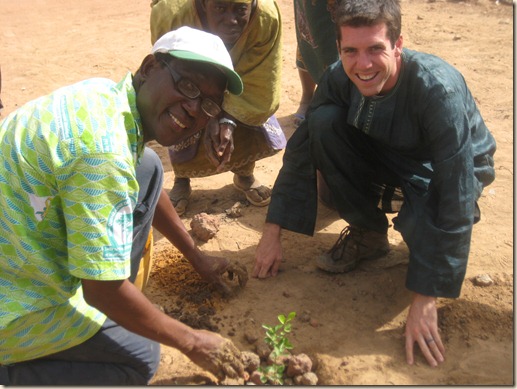
(Above) James and our wonderful trainer plant a lime tree outside of a government office as part of the training.

James will spend the next few weeks distributing trees to organizations that attended the training and helping them to plant some trees in their villages using the new method.


Thanks for Reading!

~Joye (and James)