Sunday, March 25, 2012

Update: The Coup & the Poo

So Mali’s had a coup d’etat.

Now I’m guessing that almost all readers of this post are checking our blog to make sure we’re safe and okay. Rest assured, we are. Peace Corps is monitoring the situation carefully and has been is regular contact with us since last Wednesday. Honestly, our main concern at this point is not for our safety, but for the completion of our project work. I am only one day at the bank away from finishing up work on my tree-planting project, but the banks have been closed since last Thursday! We are also very concerned for the future of Mali’s democracy, given that it was a model in the West African region, but has now become a joke. If you would like to read more on the situation, check out articles from the NY Times, Washington Post, AP, Reuters, and BBC, that latter of which has a correspondent in Bamako.

But way out in Kongodugu, we only found out about the coup through a series of text messages from Peace Corps and the US Embassy. “PCVs, please avoid Bamako tonight due to demonstrations.” “Disturbance in Bamako; US Citizens advised to stay indoors.” “PCVs, a coup d’etat has occurred, who’d a thunk?” “Curfew established; US Citizens advised to stay indoors.” And the like. For those in Bamako, my understanding is that the situation is still tense, but out in village, most Malians reacted to news of the coup with a very “c’est comme ca” (it is was it is) attitude. Even in Duguba, people do not see Bamako as affecting their daily lives; therefore, they don’t clearly see - for better or worse - how this ‘military disturbance’ should affect them either.

The whole episode reminds us of an incident that happened in the Allen household last week. For the sake of analogy, Joye will be mutiny leader Amadou Sonogo, I will be Mali’s democratically elected president ATT (nice arrangement, huh?), and my awesome cell phone will represent Mali’s democratic government. On Saturday night, just after dark, Joye took control of my cell phone – which has a flashlight – in an effort to protect herself from scorpions while going to the nyegen. Regular readers may remember that a nyegen is an outdoor, hole-in-the-ground bathroom. Clearly she believed that she could use my cell phone more effectively than I could. However, a minute after her coup d’phone, I heard her cry: “Crap! Crap! Crap!”

Joye had dropped my phone, its backing came off, and it bounced down the nyegen hole, landing in a pile of crap. Of course, all eyes turned to me to come up with a solution. Peering down into the hole with another flashlight (which I was holding), we noticed that the phone landed face down, the battery had flown out, and the SIM memory card – which holds all of the phone’s valuable information – was visible and unblemished. Let this SIM card represent the spirit of democracy, the sanctity of the Constitution, and rule by the people. It needed to be recovered.

We quickly rigged up a solution. Though it’s inconsistent to our analogy, Joye helped by digging through a trunk and finding a fridge magnet. I then fastened this to a long rope, which I skillfully lowered into the dank deep hole, Mission-Impossible style. Thanks to good aim and electron realignment, it soon clung to the back of the phone. I carefully pulled on the rope, and reluctantly, it rose out of the poop with a suction sound. All that was left was to bring in the lifeline to remove the cell phone from its malodorous environment.

This is the state of Mali’s democracy. It remains suspended between the open air, that is freedom, and a swamp of feces. Extraction from this sticky situation could mean the preservation of democracy with the upcoming presidential elections, which were set to occur at the end of the April. But one wrong tug of the rope, so precarious and fragile, could send the hope of elections and decentralization back into the fetid abyss, n’er to return. ATT, who has yet to react to the takeover, is certainly between a rock and a smelly place.

But as Joye and I watched the cell phone ascend in the thin beam of the other flashlight, we did not give up hope. We held our breath as it rose out of the nyegen hole, nervous to face the moment of truth and also because it reeked of putrid waste. Putting aside my fear of getting my hands dirty, I swiftly bent over the cell phone and successfully wheedled out the SIM memory card. We both laughed in the joy of success, before we both had to leave the revolting sight of decay and maggots.

Over the next few days, I did my best to clean off the cell phone. We rinsed it thoroughly, scrubbed the niches with Q-tips, soaked it in bleach water, and dried it in the sun. Surprisingly, it still worked, but sadly, it still stinks of poop. In the aftermath of whatever will occur here in Mali, this is an important lesson. Any solution will not rid us of the odor caused by this setback to democracy. Unless, of course, we buy a new and improved phone, which is what we did.

Let us hope that Mali can get its democracy back on course, for the sake of our projects, our villagers’ future, and the preservation of democracy in West Africa.

~James (and Joye)

Monday, March 19, 2012

Reflection: Vice Verses

Since we’re nearing the end of our service this summer, James and I have recently been reflecting quite a bit on the time we’ve spent here and the lessons we’ve learned, wondering what we had yet to share with our blog readers. While joking around about all the epic adventures we’ve been through, I decided that if we were to choose a soundtrack to these past two years, I would choose Switchfoot’s  newest album “Vice Verses.” Not only is it our favorite band to rock out to while we’re doing laundry by hand or biking to and from work, but almost every song has either inspired us or comforted us in a particularly difficult time in Mali. Thus, its in the context of this album, that I reflect on our service.

The somewhat melancholy album describes the duality of life -- striving for a reconciliation of the pain and suffering in the world with hope and the desire to do something about it. 

“I know there is meaning to it all…..a little resurrection every time I fall, You’ve got your babies, I’ve got my hearses, every blessing comes with its set of curses, I’ve got my vices, you’ve got your vice verses.”

Likewise, our life in Mali is often full of opposites, contradictions, highs, and lows. Its probably a combination of the nature of development work, the mood-swinging side effects of Mefloquine malaria prophylaxis medication, and the extreme heat, but I’m pretty sure that we’ve never felt so bipolar in our feelings and moods on a day to day basis. Indeed, when we reflect on our service we realize that some of the best and worst days of our lives have come packaged in one week. This past set of weeks has been a particularly extreme example.

“I want to thrive, not just survive. I get so down, but I won’t give up.”

After returning from the Segou Music Festival, we reached our village and were thrilled to find that the school walls were finished and that one of my (Joye) best friends, Nana, had just given birth to a healthy and beautiful baby girl. As I held the day-old baby in my arms and she gave me a big toothless grin, it was hard to hold back tears. I’ve certainly held babies before, including lots of babies in my village, but this was the child of a woman who has been my close friend for over 20 months, someone who constantly seeks and listens to my advice on nutrition, sanitation etc. I was ecstatic that I could share such an important moment with a friend who is so culturally different from me. I  thanked God that he had blessed this little girl with good health and a mother who cared enough to educate herself and her children.

“Deep down there’s a hope inside, you’ve got wings, but you’re scared to fly”

However, when we reached our host family’s house the next day and began chatting, we discovered that February had not been so kind to most families in Kongodugu. Six families had lost children under 5 years old during the short time we were gone, and many were our close friends:  the head mason for my classroom construction project, the head mason’s apprentice, and our next door neighbor the Imam’s son.

“This air is strange to me, feeling like a tragedy, I take a deep breath and close my eyes. We were born into a fight, but I’m not sentimental, this skin and bones is a rental… still looking for a home in a world where I belong, where the weak are finally strong.”

It was a lot to swallow, but Malians only allow themselves a 1-2 days to grieve before going back to their daily lives. The way they see it, death is too common here to waste large amounts of energy and feelings on it. We asked around and found out that many of the deaths were malaria or flu related –  completely treatable if the children were not so severely malnourished to begin with. Malnutrition: a problem we’d been trying to educate people on all last year through teaching the 3 food groups and planting Moringa trees. Maybe we’d been helpful, but, it seemed, it wasn’t enough.

“Feels like we’re just waiting, while our hearts are just breaking. Feels like we’ve been fighting against the tide. I want to see the earth start shaking, to see a generation waking.”

Still, we had work to do, and good work, too. So we threw ourselves into planning the PLASA tree-planting training for which James had received a USAID grant. We recorded 2 radio shows and trained people from 10 villages to plant trees in the dry season that would live long and produce leaves or fruit that would provide essential vitamins and nutrients to their diet. James was extremely satisfied with the results, as trainees repeatedly thanked him for organizing this workshop. They seemed reenergized about planting trees in their communities. Though exhausted, we couldn’t help but comment to each other how this is the kind of work we were excited to be here in Mali for, work that we couldn’t do from the US but was equipping people to make changes in their own communities.

“At last completed and complete, where tired and tears and pain subside, and laughter drinks them dry.”

Returning to village, I walked around and greeted everyone with a smile, happily boasting that we had just finished our tree-planting training in Duguba. My neighbor Miriam listened contently while I chatted away and then quietly mentioned that her 3 year old daughter Sanata had passed away. The news hit me like a brick wall. It wasn’t exactly surprising. I’d been trying to convince Miriam give her malnourished and sickly daughter protein rich foods for over a year now. But it hurt all the more because it had been one of my first mini-goals, to make her healthy.  I used to stop and play with her every time I walked through her compound (once/day) , reminding her mom to take her to Baby Weighing sessions in Duguba and add peanut powder to her food.  It was a heart wrenching reminder to both James and I of our limitations and of how hard development really is. We both struggled with the news. But in Mali, you have one good cry, take a deep breath, and keep going.

“It feels so typical, guess I’m looking for a miracle. Rise Above it.  Hear our voices rise, hear our battle cry. We will rise, like the tides. Let’s rise above it.”

That news has convinced me that nutrition should be my focus for the rest of my time here. And I’ve had some great days since, teaching women to make nutritious baby food and planning more trainings on easy solutions to malnutrition, like Moringa. 

We still have a lot of ups and a lot of downs. Some days people listen, others they are too busy to give us their time.  The days here ebb and flow. We have successes, frustrations,  and heartbreaks.  We learn and we adapt. And though this is not always cheery, it is part of the experience. Life is a two sided coin, full of joy and sorrow. We hope that recording it here will help you understand a little more about our lives and the lives of our villagers here in Mali. 

“Here’s to your bright eyes, shining like fireflies. These are my souvenirs, a memory of a lifetime. So I close my eyes, and we’re back in time. 

We were so young, we had no fears. We were so young, we had no idea. We had just begun, a song we knew but had never sung, that burned like fire in our lungs. And life was just happening.

I wouldn’t trade it for anything.  My souvenirs.”

- Joye (and James)

Wednesday, March 7, 2012

Pictures: ‘March’ ing Forward

IMG_2428 IMG_2438

In the last month, the village has finished the mudbrick walls of the school! Joye and her work partner made multiple trips to a larger city 20 km away organizing the delivery of cement, doors, windows and tin paid for by a USAID grant. Now, the village masons will work together to install the roof, doors, and windows in the next few weeks!

IMG_2525 IMG_2526  IMG_2557 IMG_2570

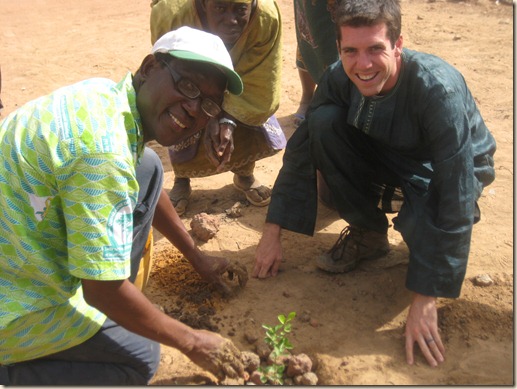
James also just completed a Dry-Season Tree Planting Workshop where he organized a trainer from Association Vigne in  Bamako to come and teach 80 individuals from 10 villages a new method known as PLASA. Villagers learned that a little extra work up front will greatly increase the longevity and robustness of the trees planted. This new PLASA method requires minimal watering and upkeep, but prevents the trees from dying without rain. The attendees of the training expressed excitement that they now felt equipped and reinvigorated about contributing to reforestation in their communities.IMG_2556

(Above) James and our wonderful trainer plant a lime tree outside of a government office as part of the training.

James will spend the next few weeks distributing trees to organizations that attended the training and helping them to plant some trees in their villages using the new method.


Thanks for Reading!

~Joye (and James)

Monday, March 5, 2012

Update: To Bamako & Back

“I have diarrhea right now! If we don’t stop immediately, I will defecate on your bus!”

It was ridiculous that it had come to this. But we had talked to the driver before, and only now that we were at our stop did he decide not to comply. I had already ordered him to pull over, shouting over the other passenger's heads, and when he refused I adopted a new strategy. It worked; he pulled over immediately, and the other passengers were so busy laughing that no one was bitter over the minor inconvenience. Soon we were off the bus, and I had another story to tell concerning the insanity of Malian transportation.

Whereas in 2011 Joye and I would travel to Bamako about once every three months, during this past February we went there and back three times. Since each one-way trip takes about 12 hours on the road, this means we spent 72 hours (or three days) in a Malian bus, which is considered by most Peace Corps Volunteers to be the worst part of Mali. They're hot, always late, always smell of a boy’s locker room, and moreover, the people who comprise the Mali’s transportation industry are unlike all other Malians in that they are not hospitable, accommodating, or well-intentioned.  However, the reasons for our traveling made the efforts worth our while. Here is a little of what we did in February:

Two of our trips to Bamako were the bookends to a fantastic visit from Joye’s siblings, Scott and Hope. During their brief 10-day stay, we visited Kongodugu (our site) and its weekly market and spent a few days relaxing at a quasi-resort outside of Bamako. We also attended the annual Segou Music Festival, which did not fail to impress with its numerous artisans, delicious Capitaine fish, and world-renown musicians - Salif Keita anyone? It was great to spend so much quality time with Scott and Hope, especially without the distractions of Internet and texting interfering with our conversation. To see if they agree, maybe we’ll post something from them soon about their impressions of Mali. Here are some pics:

IMG_2452 IMG_2499

Moreover, the month started with a Food Security Task Force meeting in Bamako, where about 30 volunteers gathered for a week to utilize and improve our food security program. About 12 of us started out the week by developing resources, such as a Bambara cookbook of nutritious recipes and a video showcasing a water-conserving tree-planting method. Joye worked on compiling a radio script manual that will largely draw from our own show, while I brainstormed and drafted planning materials for a West Africa Food Security Summit, which will hopefully happen between April 10-14. To me, all of these projects are very exciting! We also voted for new leadership for our Task Force, since many volunteers (including us) will be finished within the next six months.

One final noteworthy travel story is that, after the Task Force meeting in Bamako, Joye and I biked back to our site Kongodugu from Koutiala, down a dirt road that cut through five other villages we had not visited before. In addition to seeing the new sights, we were fascinated to hear each subsequent village’s dialect of Mianka (a native language to our region) gradually evolve into Kongodugu’s form. But it was a tiring journey - over 80 kilometers (50 miles) in the hot Malian sun. It’s funny how some Malians are terribly impressed by this feat, which took us about eight hours with a lunch break, while other are surprised we could not do it in four or five. Either way, we’re proud of the accomplishment and enjoyed the adventure.

IMG_2403 IMG_2422

Thanks for reading!      – James (& Joye)

Monday, January 30, 2012

Update: Brick by Brick

The parts of our Peace Corps service that will have the most significant effects are the small changes we make in peoples minds concerning the way they conduct themselves in business, taking care of their children, etc. It’s the fact that my neighbor now adds peanut powder to her children’s breakfast porridge because she believes me that they their bloated bellies are a result of a lack of protein. That people seem to recognize that a husband and wife can treat each other with respect and be friends. That people in Yorosso think about planting trees as a necessity rather than a luxury. A lot of the little lessons and capacity building comes through our radio show, our periodic village wide awareness activities, and school-based trainings. And its through these activities, we have truly come to appreciate the role of a basic education in the ability of a community to develop. It may seem obvious, but often people do not realized that individuals are more organized, efficient, creative, and resourceful when they have basic literacy and mathematic skills.

IMG_2323 IMG_2326 

Therefore, though Peace Corps generally discourages construction projects, we’ve decided to spend a large part of our last 6 months of service focusing on what our community identified as their first priority when requesting a volunteer, building 3 traditional mudbrick classrooms, with the tin roof, cement floors, metal doors, and windows being funded by Peace Corps. Though we have paid teachers for these classes, the courses are currently being taught outdoors due to a general lack of anywhere else to study. Our hope is that these classrooms, though far from ideal in US standards, will serve as a safe, distraction-free, center for study for the next 10-15 years and will improve the overall literacy level in our village. However, the most exciting part of this project is that we are not building the school, but the community is doing 99.99% of the work (See pictures below for the other .01%). As of mid-January, they  made 15,000 mudbricks and transported them to the building site by donkey cart. Then this week, 200 men showed up for the ground breaking ceremony and after they dug the foundation, the village chief laid the first mudbrick to kick off  building the classrooms.  They will be finished with the walls in the next two weeks. Then, hopefully the roofing and cement work can be done at the end of February/early March. We’re thrilled to see our village realize that through unified hard work and goal-setting, they can achieve great things without a huge investment from outside resources.

IMG_2333 IMG_2338 IMG_2352 IMG_2364 IMG_2328

On another note, Jim has submitted a tree-planting project for approval soon.  (Above right) Jim and his workpartner who owns a tree nursury are coordinating a tree planting effort in March that will teach 25 associations a new method to allow trees to be planted in dry season which requires little watering. Around 2000 trees will be planted in our commune do to his hard word, so we certainly have a busy few months ahead of us!

IMG_2378 IMG_2384

~ Joye (and James)

Sunday, January 29, 2012

Guest Post: A Parent’s Perspective

Since we’re sure you all are tired of hearing only from us all the time, we asked Joye’s family to write down their observations about Mali. Here are Joye’s Dad’s comments…


Because there is so much I could talk about, I have tried to highlight a few unique things that made a big impression on me during our three week Mali vacation.

Malian Transportation

The bus trip from Bamako to Koutiala on day #3 of our visit was something else. Two seats on the right, two on the left, with a narrow aisle down the middle. Except, this narrow aisle had about 10 jugs upside down for seats to accommodate additional passengers. Nobody yell fire, please. Because it’s “cold season” nobody would roll the window down and it got very hot. But that’s okay because the bus did stop for one 5-minute stretch and potty break about 4 hours into the 7-hour trip. I was afraid to drink anything for fear my tiny bladder would cause a major scene. I sat with Jim, David and Carrie (another PCV) in the back row. There was one Malian guy ahead of me who had his black leather jacket on for the entire trip, dripping in sweat. Jim and Joye do this trip all the time, and in hot season! It was good to experience it (just) once!

Cars, especially taxi cabs, own the road in Mali. If you’re a chicken, dog, pig, goat, sheep, cow, donkey cart, bicycler, moto-biker, moto-taxi, or even a pedestrian, then get out of the way, ‘cause I’m not going to slow down! I may honk to warn you of your impending doom, but my foot’s not leaving the accelerator. Busses trump cars, and large trucks beat busses. Women with babies strapped to their backs were driving motos day and night, dodging in and out of traffic at speeds of probably 30+ mph. Thankfully, we observed no incidents. I noticed that every taxi we rode in had a cracked front windshield except, as David pointed out, the very last ride to the airport! I wasn’t surprised!

Moto-taxis (left) don’t carry the same street clout that a taxi cab does. (Right) Boy on the way to market with chicken to sell

clip_image002clip_image004

Baobab Tree

Some Baobob trees were lean and gangly, some huge and intimidating, some were happy and some were spooky, but all of them could have played a role in The Wizard of Oz! I have never seen a tree like the Baobab and was fascinated with them the entire trip. Like snowflakes and fingerprints, they are everywhere, come in all shapes and sizes, but there are no two alike. We even sampled the fruit it produces which was entirely new to my taste buds. My favorite photos from the trip include Baobabs. Two are below:

clip_image006clip_image008

(Left) Baobabs at Sunset on Christmas (Right)Mom, Joye, Jim, and David pose next to an average size Baobab. Some trunks can get much larger!

Malian Dressclip_image010

Someone’s going to make a lot of money when they figure out how to market Malian clothing into the United States. One of our favorite things to do was pick out fabric at village markets, find a trustworthy tailor, and have the tailor make a variety of shirts, pants, and other articles. I wear the shirts to work now in the States! For the buyer of a shirt you can’t beat the $5 price – for the seller one shirt may provide the profit you need to put food on your table that evening.

(right) Jim’s work partner, Rube Dao, tailored this “Christmas shirt.”

Temperature Swings

One of my first journal entries was “Today’s Weather: mostly sunny, 89-91 degrees, breezy in morning. 60 tonight.” The daily entry for the rest of the trip might as well have been “Weather: see yesterday!” For the locals, the 30-degree day/night temperature drop requires, of course, parkas if they weren’t already wearing them throughout the day. (It is winter, you know.) I kidded Numujo and Ashata (a.k.a., Jim and Joye) that even they have grown thin-skinned and wondered out loud if they will ever move north of Kentucky when they return to the States. Even Cindy, David, and I were there long enough that we started feeling the cold in the morning towards the end of our stay.

Medical

Okay, so I was the bonehead who rolled his ankle during our descent from the Dogon Cliffs, which, on the positive side, makes me partially qualified to rate the medical competency of this country. My left ankle swelled significantly in the next 30 minutes and, as we settled in for lunch, the village medicine man was summoned to manipulate my foot and ensure nothing was broken. In retrospect, he did a pretty good job even though the special leaf ointment he put on my ankle really didn’t do much. He did validate his authenticity by showing us his license (like I had any clue what the piece of paper he held up meant). Five days later in the capitol of Bamako, I visited a French clinic “Polyclinique – Pasteur” to have a more educated doctor’s opinion, and despite an ugly black and blue foot by then, he said I was fit for flying. Other than the swelling, the pain was never that bad.

Final Ponderings and Pictures

  • Almost every day I’d see women spit, a rare site in America.
  • The Malian rice and sauce is delicious and nutritious if you can find and afford it (unfortunately, it appears many cannot).
  • I spotted one Malian child wearing a Michigan State University sweatshirt. It is noteworthy that nowhere on this trip did I see a U of M anything. Go Green!
  • Malians like loud music, even when it doesn’t make sense such as on a long bus ride when you’d rather nap!
  • A lengthy trip to Africa is a good place to grow a beard if you have never done so.

Although I struggled more than anybody trying to learn the Bambara language, this was an amazing experience. I am so grateful to have a son-in-law who not only put up with his in-laws for three entire weeks, but wined and dined them with incredible hospitality. Parting was still not easy, but we look forward to their return to the States in six months. We are excited about Jim completing his Master’s thesis, and seeing Joye’s new elementary school building project come to fruition.clip_image012

Eating Malian Style (with our hands)

Saturday, January 7, 2012

Update: Happy Holidays from Mali!

Though last year we found ourselves somewhat homesick for America around this time, this year we were so busy that we hardly had time to think about it! Joye’s parents and younger brother came to visit for a few weeks and we had a blast showing them around our village and the rest of Mali. They’re still settling in back home but hopefully we’ll be able to post their impressions of Mali for everyone to read. Meanwhile, here’s some highlights and pictures of our trip from Bamako to Kongodugu (our village) to Dogon Country and Mopti:


When we arrived in village, the whole town had gathered at our doorstep to throw a huge welcome party- including dancing and balophones (Large Malian Xylophones made of wood).

Dec 2011-Kallgren Christmas Mali Trip 448 Dec 2011-Kallgren Christmas Mali Trip 453

The village also started to bring bricks for the new traditional mudbrick classrooms that will become one of our final projects in Mali.

 Kallgren Kamera 339 Kallgren Kamera 412

Joye’s family learned to eat with their hands Malian Style. Afterwards, they were extra enthusiastic about helping us teach multiple hand washing awareness activities.Dec 2011-Kallgren Christmas Mali Trip 518

After spending Christmas in village, we headed north to Dogon Country. We all enjoyed dinner and guava juice at a restaurant gearing up for a 2 day hike up and down the cliffs.

 Dec 2011-Kallgren Christmas Mali Trip 559 Dec 2011-Kallgren Christmas Mali Trip 588

Dec 2011-Kallgren Christmas Mali Trip 692  Dec 2011-Kallgren Christmas Mali Trip 717

We had an amazing hike, complete with adventurous rides  across sand dunes, great views from the cliff, and only 1 sprained ankle (get better soon, Dad!).


We ended the trip by spending the New Years in Mopti touring Bozo fishing villages and eating a wonderful meal at the Maison Rouge Hotel.

Dec 2011-Kallgren Christmas Mali Trip 745 Dec 2011-Kallgren Christmas Mali Trip 756 

We wish all our readers a safe and blessed New Year and hope you’re looking forward to 2012 as much as we are!

-Joye and James